
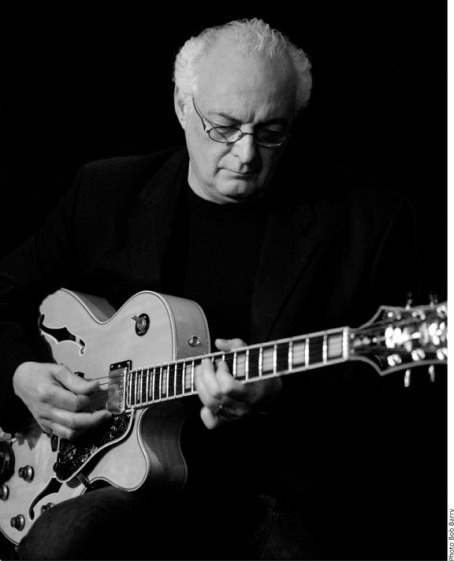
The following was written by Lauri Chiodini Touchette.
John Chiodini’s earliest musical memory was Gene Autry strumming on the T.V. “I noticed he always finished the song before he got ambushed,” John chuckled. “I guess that made an impression on me.” That blend of humor and keen observation would carry through his entire life, which began in New England.
John Chiodini was born in Providence, Rhode Island. By age ten, he was already on the path to a lifelong calling in music – taking private lessons and performing with a local youth band called the “Busy Bees.” He played in jazz and rock groups throughout high school and led his own ensemble while attending the University of Rhode Island. John majored in Physics; and although he had never worked professionally as a physicist, he said that over the years, the two fields – Music and Physics, had grown closer and closer together. He also took a special interest in astronomy. He ultimately chose to devote his life to music – a decision that would lead to an extraordinary career.
After college, John immersed himself in New England’s thriving jazz scene, launching a professional career that would span more than six decades. Throughout the 1960s and 1970s, he worked extensively in clubs, recording studios, and theaters before earning a chair in the legendary Boston Pops Orchestra under Arthur Fiedler, where he also wrote and orchestrated music for the ensemble. Audiences nationwide came to know his playing through concerts, recordings, tours, and the beloved PBS series Evening at Pops. He also performed with the Boston Symphony Orchestra under Seiji Ozawa and toured nationally with the renowned Maynard Ferguson Orchestra. For all his technical perfection and big-band discipline, John possessed an equally irrepressible sense of humor. In the 1970s, he appeared on The Gong Show and won the competition with an original song he wrote called “Don’t Abuse Your Nose.” Dressed in a doctor’s uniform and performing under the name Dr. Lanasa, John played electric guitar and delivered a wildly energetic solo that brought his musical talent and sense of humor together in unforgettable fashion.
In the late 1970s, John relocated to Los Angeles, where his reputation as an elite craftsman spread quickly. Producers, arrangers, composers, and artists recognized something exceptional in his playing: his guitar wasn’t simply an instrument, but an elegant, expressive, and endlessly inventive voice. John understood music in a way that went far beyond notes. He explained jazz as a conversation between notes. He listened closely to how the notes related to one another and responded to the conversation they created. In those moments, John was completely present, deeply connected not only to his instrument, but to the conversation taking place between the notes and the musicians playing them. There was joy, contentment, and anticipation in the way he played, as though each note invited the next one to emerge. For John, music was a language, and his guitar became his voice within that language.
Long before electronic instruments, MIDI, and digital recording became industry standards, John embraced them with open curiosity. Whether holding an acoustic guitar or programming synthesizers, he combined tradition with innovation, approaching every new technology with the joy of a student.
In 1987, he released his critically acclaimed MCA album, Weightless, writing, composing, arranging, and performing the entire project. The album earned strong radio airplay, reached the Radio & Records Top 30 Jazz chart, and was featured as a recommended recording in Billboard. As John described his creative philosophy in an interview – The Evening Times (Columnist John Worsley), July 3–9, 1987 / Archival collection of the Chiodini Family: “I have many interests. My music is about something. All these songs are portraits, grooves that flow from my perceptions.”
Over the following decades, John became one of the industry’s most respected and sought-after studio guitarists. Known for his versatility and refined technique, John was trusted on stage and in the studio by an astonishing range of icons, including Peggy Lee, Natalie Cole, Paul McCartney, Barbara Streisand, Tony Bennett, Céline Dion, Michael Bublé, Barry Manilow, Michael Bolton, Kenny Rogers, Nina Simone, Shirley Horn, Nancy Wilson, Louis Bellson, Hubert Laws, Dr. John, Buddy DeFranco, Diane Schuur, Bobby Caldwell, Luciano Pavarotti, Perry Como, Dinah Shore, The Mike Douglas Show, and The Tonight Show.
Beyond performing with major headliners and the Los Angeles Orchestra, John collaborated closely with many of the industry’s master producers and arrangers, including George Duke, André Fischer, David Foster, Tommy LiPuma, Johnny Mandel, Phil Ramone, and Al Schmitt.
His guitar work also helped shape film and television scores across more than three decades, including Foul Play (1978), The Incredible Hulk (1979–80), Galactica (1980), Xanadu (1980), Zoot Suit (1982), The Dukes of Hazzard (1983–84), Biloxi Blues (1988), Great Performances (1994), King of the Hill (1998–99), There’s Something About Mary (1998), Invincible (2006), and Boston Legal (2007–08).
Yet what colleagues admired most was John’s extraordinary generosity. He possessed a rare ability to elevate everyone around him – he listened deeply, encouraged others, and collaborated entirely without ego. Whether on stage with global superstars or working in a small studio, he treated every musician with equal warmth and respect.
A particularly cherished partnership was with tubist Jim Self. John and Jim created music together for nearly a decade, producing five albums between 2017 and 2024; Feels So Good, Touch and Go, Hangin’ Out, The Light Fantastic, and Floating in Winter. John’s musical connection with Jim continued into 2025, when he performed on Self’s My America 3: My Country, released June 13, 2025. Even through the isolation of the pandemic, John and Jim continued gathering simply because they couldn’t imagine life without making music together.
Beyond his celebrated professional career, John was a devoted father who eagerly lent his genius to his daughters’ creative ventures. When they produced public access shows for Time Warner Cable – including “Carolyn’s Showtime” (currently: Carolyncable.com and the YouTube channel Carolyn Chiodini-Cable Spotlit), “Lauri’s Studio” (currently: www.redbubble.com/people/lctartandmedia), and “Amy’s Bawdy Booty” – John served as their musical director and featured performer. His involvement was a testament to his unconditional support, seamlessly blending his mastery as an artist with his deep love and pride as a dad.
Above all, John was a devoted husband, father, grandfather, and friend. His beloved wife, Ginger, remained his greatest companion throughout a musical journey that carried them across stages, studios, and continents, and his family served as the inspiration behind some of his most beautiful compositions.
Those who knew John will remember his quick wit, quiet kindness, gentle humility, and boundless intellect. His greatest gift extended far beyond awards and credits: it was his capacity to create beauty, connect deeply through music, and leave every recording session, stage, and life richer than he found it. John’s legacy lives on through his family, the music he left behind and the community of musicians whose lives were touched by his spirit.