
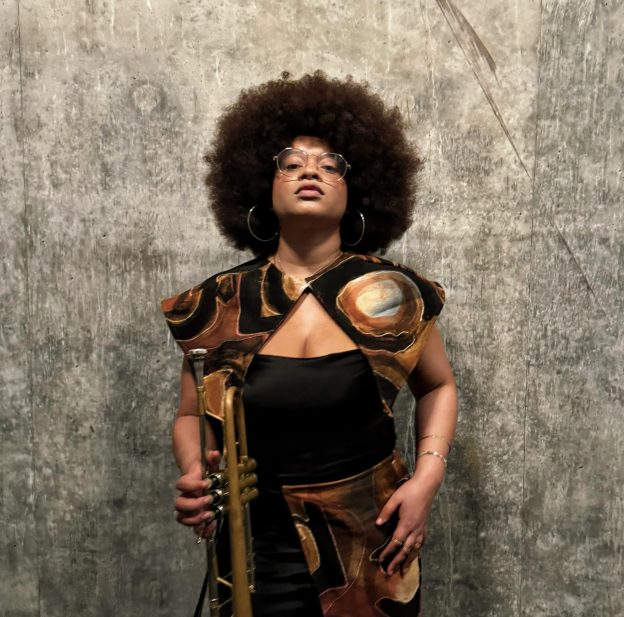
AFM Local 47 Member Spotlight
AFM Local 47 member Tatiana Tate is an acclaimed trumpeter, composer, and bandleader based in Los Angeles. She is known for blending jazz tradition with modern soul, funk and R&B. Tatiana has performed for audiences worldwide, sharing the stage with legends like Stevie Wonder and Macklemore, and captivating millions in NPR’s Tiny Desk series. She has appeared in ESPN’s Super Bowl commercials and is the founder of the Melanin Horns, an acclaimed brass collective. She will be releasing her first project this year entitled “Betty Hubbard,” a jazz take on west coast G Funk. Imagine Snoop Dogg meets Miles Davis.
Tatiana talked with Local 47 about her journey as a trumpeter in Los Angeles.
Local 47: You recently gained local fame for your viral trumpet performance at Dodger Stadium. How did that come about?
TT: I got an email one day asking me if I wanted to play for the Dodgers. The Dodgers wanted to make Edwin Diaz’s first time pitching with the Dodgers a special moment. There is a song, “Narco,” by Timmy Trumpet that was the entrance song for Diaz when he was with the Mets. The Dodgers wanted to give Diaz that same level of respect in LA and asked me to perform the song for Diaz’s Dodgers entrance. It was an amazing moment. The crowd was simply electric. And I am still just in awe.
As someone who grew up going to Dodgers games with my dad and my pastor, I am grateful for the opportunity to play for my city.
Local 47: When did you first become interested in the trumpet?
TT: I’ve been playing music since I was about five years old. I have an older brother who was a part of the Boys and Girls Club in elementary school. They had a drum line. As he got older, my parents wanted to get him more into music, so we joined a local program in Long Beach called Rhythm Regiment Drum Corps. It was led by a young woman by the name of Terry Moore. She basically taught us drums from all over the world, just about any percussion instrument you can think of. She taught us how to play.
One day I went into rehearsal, and she told me it was time to learn my next instrument. She handed me a trombone. I was a little kid, probably eight years old at the time, so my arms couldn’t handle the trombone. She handed me a tuba, which was too heavy. Then she gave me a trumpet. It was still too heavy, but I said that this is the one I wanted to try. When I went home and came back, I was able to play a whole major scale. She gave me a finger chart. I took it home, and the week I came back, I was able to play it. So, that’s how I knew that was the instrument for me.
When I got into middle school, I joined a nonprofit in Long Beach called Jazz Angels. They teach kids how to play jazz in an easy and digestible way. So not only was that program part of my foundation, but I also worked through that nonprofit for a few years teaching kids. That program really fostered the education side of my career.
In addition to Jazz Angeles, I support several non-profits that make jazz education easily accessible, including the Just Jazz Foundation and Girls Play Trumpets Too New Orleans.
Local 47: What kind of music were you listening to at a young age?
TT: A lot of Earth Wind and Fire, Tower of Power. I fell in love with the sounds of the horns. And then with my teacher, Ms. Terry, she got me into listening to a variety of famous trumpeters. Some of my trumpet influences include Miles Davis, Roy Hargrove, Freddie Hubbard, and Clora Bryant.
Local 47: When people think of jazz cities, they probably think of cities like New Orleans, New York, and Chicago. How is the LA jazz scene?
TT: It’s experiencing something of a jazz renaissance. We have a new Blue Note, for example, among many other exciting things. People are embracing jazz and live music in LA, which has been really good for my career and the careers of my peers, because people want to hear jazz. They want to hear what our voice sounds like, because jazz is often that music that reflects the times you’re going through. People are really interested to hear what we have to say.
An example of this growing interest are pop-up jazz clubs. I was a part of this series called Jazz in Compton, where we would do pop-up jazz at a farm in Compton and have150 to 200 people come to hear live jazz at a farm with animals. People want the music so bad that we’re willing to just pop up at a venue. And you’re seeing a lot more events where people are renting spaces to host jazz music. In the past, you had to go to a specific club to hear jazz. Now you can find different events and curations throughout the week. I post a lot on my social media about where to find jazz events.
I think what’s particularly exciting about jazz is the young people, especially in LA. We’re the next generation and are inspiring the people in our age group to get really excited about jazz. Growing up, I saw jazz as an older people thing. But now I’m playing with my peers. And our peers are coming to watch us. It’s becoming everyone’s music.
Local 47: Do you have a style of music that you are particularly drawn to?
TT: I really love soul music.
I consider myself a genre-bending artist, but I love to embed a lot of jazz elements into R&B. I love the iconic horns of Earth, Wind and Fire but I also love the softness and the space of Miles Davis and try to combine the two styles within my sets.
A lot of the times when I perform, I’ll take a common song like Cantaloupe Island but then play different songs on top of that. You can play Biggie over Cantaloupe Island, for example. I like to educate people about how jazz influenced so much of what we listen to today.
Local 47:Tell us a bit about your work.
TT: I’m a professional trumpet player, arranger, and composer and tour with major artists. I also write and arrange for different artists. So, if I’m not on that tour, some artists might come to me and say, “Hey, can you write horns?”
I also have my own band, which I tour and perform with all over.
Some well known artists I’ve played for include Stevie Wonder, Arturo Sandoval, Doechii, Kamasi Washington, and Lizzo. I just finished playing with Kamasi Washington and his crew over the weekend. With Doechii, I played with her on NPR’s Tiny Deski and got to arrange the horns for it.
Also, I’ve done television work, including Sugar for Apple TV, Reasonable Doubt on Hulu, and the new show Cross on Amazon Prime Video.
Local 47: You have an active social media presence. How did that begin?
TT: I started investing in social media a couple of years ago. I feel like I really cracked the code in terms of giving people the information that they need and creating content that they enjoy. I often get comments on my trumpet videos like, “I didn’t know the trumpet could sound like this.” Because we leave the smooth and sensual stuff to the saxophones, we don’t think about the trumpet in that way. I realized that I was able to use the power of social media to change the way people think about the trumpet. The trumpet is not always aggressive and loud. It can be soft, beautiful, and lyrical. And it doesn’t always have to be smooth jazz. It can really be anything that you want it to be.
Local 47: How has union membership benefited your career?
TT: I think a big worry for working musicians is payment, especially when working a variety of gigs. But when somebody tells me a job is union, it kind of gives me a breath of fresh air to say, “Hey, I’m going to get paid. I’m going to get a fair rate. I’m going to be protected.” And for those who use the different union programs where that money goes towards things like insurance, I think it’s especially beneficial to us freelance musicians. It’s great to know that we have a union on our side advocating for us in an ever-changing music industry.
Follow Tatiana on Instagram and find out more about her work via her website.