
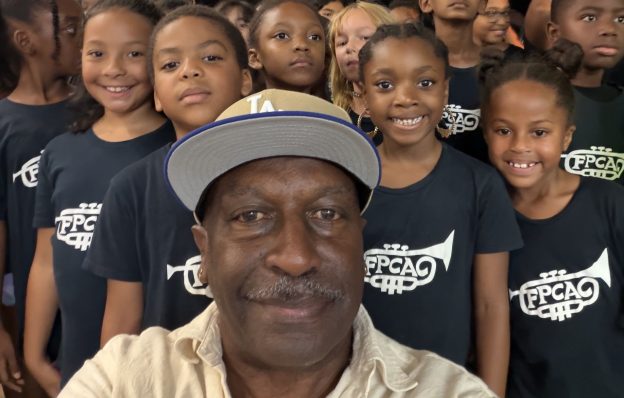
Member Spotlight
AFM Local 47 member and trumpeter Fernando Pullum moved to Los Angeles in 1983 to follow his dream of becoming an educator and professional musician. He assumed the music program at L.A.’s Washington Prep High School. Under his tutelage, the program thrived. In 1989, Los Angeles Unified School District recognized Fernando’s music program as the first music magnet in South Los Angeles.
During the years that followed, 100% of Fernando’s students graduated with a high school diploma and only one student failed to enroll in college during the next fifteen years. Fernando has been recognized by many organizations and individuals throughout his tenure, including Oprah, VH-1, the John Lennon Foundation and the State of California as its teacher of the year. He has performed and recorded with many industry greats, such as Stevie Wonder, Ella Fitzgerald, Jackson Browne, Etta James, Alicia Keys, The Temptations , Fishbone and more.
Over the years, Fernando’s students have performed for many dignitaries, including President Ford and Prince Charles. The students have performed with Jackson Browne, Stevie Wonder, Herbie Hancock, Lionel Hampton, Wynton Marsalis, Al Jarreau, Crosby, Stills, Nash, and many other incredible musicians. They have opened the Playboy Jazz Festival four times and traveled to Cuba, Brazil, Spain, and New York. Six of his former students have won Grammys.
AFM Local 47 had the pleasure of sitting down and talking with Fernando about his music career and his role as the Executive Director of the Fernando Pullum Community Arts Center.
Local 47: Thank you for taking the time out of your busy schedule to talk with us. You grew up in Chicago. What brought you to Los Angeles?
FP: I came here because I wanted to first and foremost teach. And I wanted to play too, of course. After graduating from the University of Michigan, I came out here with my college band and discovered that it’s warm here! And my grandmother lived here.
When I came here, I had been working in Detroit during the weekends because the music school at Michigan was only for classical. We had a jazz band, but you couldn’t even practice in the school of music. You practiced down in the hall where the marching band rehearsed.
I would go to Detroit every weekend and earn money and play with some of the jazz bands. And then I came out here and I was doing the same. I did session work, played various side gigs, and did TV commercials.
Local 47: How did you get into teaching?
FP: I took the test at LA Unified and then discovered that there was somewhat of a glut of music teachers in the area. I was told, “You won’t have a chance.” I did some substitute teaching work in the meantime. One day I was playing fundraiser at a local high school called George Washington High School, which is in South Los Angeles. The founders of the Crips gang actually met at that school, where one of the co-founders, Stanley “Tookie” Williams attended.
So, at the fundraiser, I heard the principal speak. His name was George McKenna. One of Denzel Washington’s first movies, The George McKenna Story, was about the principal.
After hearing McKenna speak, I thought, “Man, I would love to teach at that school.” The next morning, I got a call from the counselor from that school who happened to be in my grandmother’s choir, and she asked me if I wanted to interview for a job as a band director. I went out and talked to McKenna, and he was kind of a tough guy, and he said, “Man, you can’t do this job.” I said, “Yes, I can. I can do it.” He said, “We have no money.” I said “I don’t need money. I’m going to do this job.” I ended up getting the job and the rest was history.
Local 47: What was the school environment like when you first started?
FP: Not good. People were glorifying getting poor grades. Frankly, I was trying to quit on a weekly basis. It was so crazy. I can’t get anyone to do anything. But then I realized that kids think that teachers come from a great environment. So, for the very first time, I admitted to the kids that my mom was a drug addict, and that I grew up in a rough neighborhood. I was basically trying to tell the kids that they’re responsible for where they end up, and they’re responsible for themselves no matter what environment they came from.
They took my challenge, and they listened to me. They started working. We started with two kids in the band. When this TA and I would go play gigs around the city, those kids would come back and say, “Man, we had dinner at a hotel.” And then the kids started getting interested.
Then eventually the Hollywood Bowl folks approached us and they were doing the Playboy Jazz Festival at the time. And they wanted to do something in the community. So, they asked me, “Could I put a band together?” So, we didn’t have a band at all. I took a Thad Jones song and played it to the students, and I said, “Hey, hey, this is a group of kids from New Orleans.” And they believed me. I said, you guys can do what these kids from New Orleans did.
After we finished the song, I admitted to them that the song was from a professional band. I taught myself a lesson at the time: people tend to project their own limitations on other people. So now I just play whatever I want to perform. That’s what I do. I don’t think about the level at all.
And then academically, I learned to stop asking kids how they are going to college. Because by doing so, you make it optional. Because in Beverly Hills, they don’t ask people if they’re going to college. They ask them which college. I took that approach and it worked. You must change your expectations with everything you’re doing around the kids. When I did that, the whole planet changed. It was just a seismic shift in the outcomes.
Local 47: Can you share with us a bit bout the community arts center? It’s great to see such a resource available to kids interested in the arts.
FP: It started off with an after-school program. I began with 100 kids. I’m at 1,600 right now. Anyone is free to attend. Tuition is free, which is the hard part because you have to find the money from somewhere. We’ve had some great artists come in and play with us to help raise money, including John Mayer, Aloe Blacc, and Jackson Browne. They were great and would sit in and play with the kids. I’ve had Wayne Shorter teaching. And Stevie Wonder played with us as well.
Local 47: The center has quite a variety of classes, whether it’s music, drama, or filmmaking. Is there collaboration between the different programs?
FP: Yes. Our biggest program collaboration would be the musicals. We do two major musicals a year. A lot of people like to be involved in them because they can get to those skills faster than playing the instrument. Singing and dancing tends to be a faster track than learning a music instrument.
Local 47: Are the music classes focused on a certain genre, like jazz?
FP: We offer everything because I think if you’re going to be a working musician, you must be able to play everything. I don’t want to be a snob because I’ve seen that happen too many times. People say “I’m a jazz cat.” “Oh, I’m a classical guy.” So, my philosophy is just to play music.
Local 47: Tell us a little bit about your experience with the union and your involvement with it.
FP: Local 47 members have always been helpful to me. Bobby Shew took me to sessions when I moved to town. He also introduced me to Leslie Drayton. I worked Leslie for years and eventually played in Gerald Wilson’s band. Lalo Schifrin was also extremely helpful. He was a great gentleman. He followed up with all of his promises.
I’m excited about the partnership that we have coming up with the Local 47 and that we’re going to be able to have musicians come in as mentors from the local union. At the conclusion of it, the kids will play a concert with those professionals and then they will gain membership into the union.
And they’re getting paid. That’s always great when they see money out of it.