
Member Spotlight
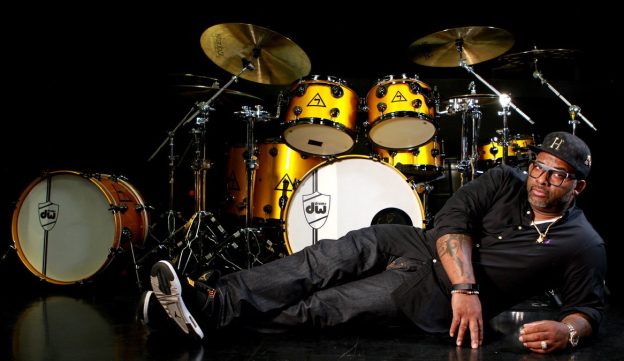
AFM Local 47 member Trevor Lawrence, Jr. is a multi-Grammy Award winning drummer, producer, podcast host, and developer. His music credits include working with Dre, Eminem, LeeAnn Rimes, Euge Groove, Lauren Daigle, Alicia Keys, Herbie Hancock, and many other artists. You can learn more about him at trevorlawrencejr.com and browse his apps and plugins at trevbeatsmultimedia.com. Local 47 had the pleasure of sitting down with Trevor and talking about his music career.
Local 47: What age did you start to become interested in drums?
TL: Very early, probably since I was two years old. My mom said she wanted to be a drummer, but my grandparents said no. So, she joked that if she had a kid, she wanted him or her to play drums.
I am fortunate to come from a very musical family. My grandfather Ira Tucker Sr. won a Grammy with his group The Dixie Hummingbirds the year I was born in 1974. My mother and father met as original members of Stevie Wonder’s backing vocal group, Wonderlove. My mother became a member of the ’70s Supremes, and she toured with Joe Cocker and quite a few other people.
My father wrote and produced the song, “I’m So Excited,” and played sax on hundreds of records. And then he produced a lot of music from the Pointer Sisters to Jimmy Cliff to Sheryl Lee Ralph to all types of artists.
That’s what I grew up seeing. So, we were also early in the home studio buzz in the ’80s, like with real consoles and real gear. So, at any given time when I was in middle school, I would come home and there’d be people like Milli Vanilli playing hacky- sack in my backyard. One day it might be Rance Allen, the next day Norman Connors, and another day it might be Norman Brown.
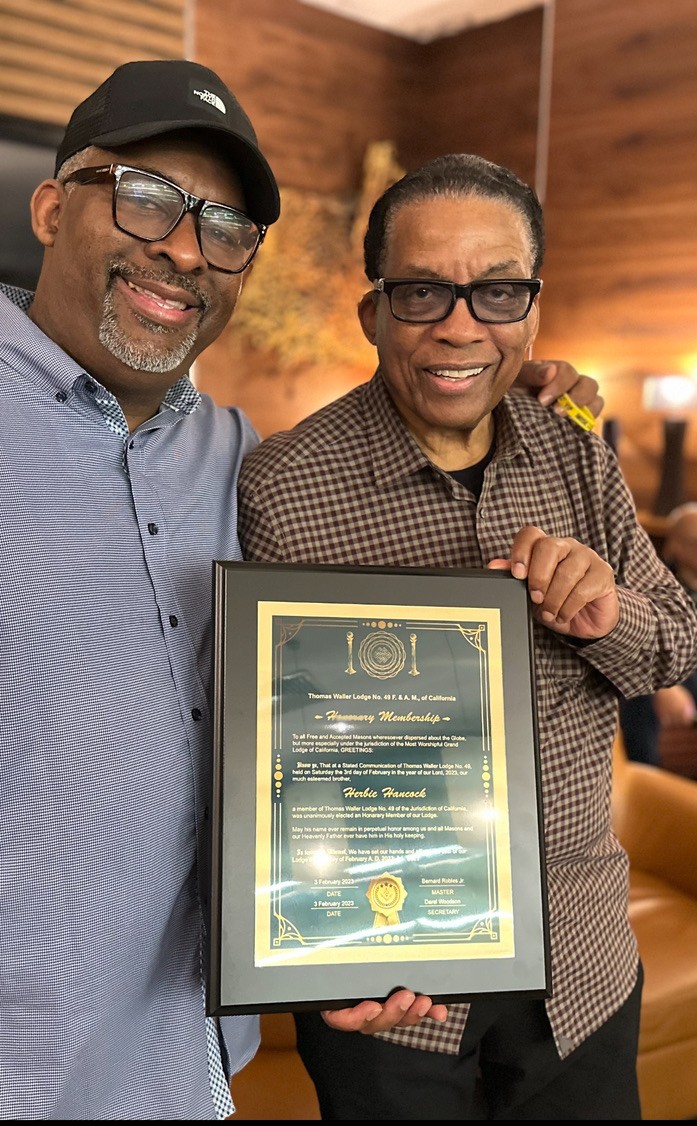
Trevor with Herbie Hancock. Trevor toured with Herbie for years.
I had a studio early on. I was into the hip hop movement very early but also just as much into jazz. I got to play with Dizzy when I was 15 at the Monterey Jazz Festival. My first band was myself, Mike Elizondo, who’s maybe one of the greatest producers/ composers of modern music, and John Daversa, one of the great composers and jazz trumpet players of our generation, and a guitarist/ composer by the name of Justin Morrell. That was my first band in middle school.
And then we all went to high school together. We all went to Hamilton High School, so that was basically the LaGuardia of L.A. One of the biggest mix engineers in history also went there with us, Manny Marroquin.
But I have to stress that the hip hop development was equally as much as the jazz development, and that came into play a lot later in my life because at one point I was employed as a producer by Dre, and I was moonlighting, touring with Herbie Hancock. So that was my life for like a decade. I started with Dre in 2009 as a producer but started working with him in the mid 90’s, and I started with Herbie in 2010. The last tour I did with Herbie was in 2024. I toured with them all over the world from 2010 until pretty much 2019, and then I kind of stepped out so I could be with my son when he was a teenager. I didn’t want to be gone much during those years. I still told Herbie that whenever he needed me I always would help him out since a lot of people didn’t know that show.
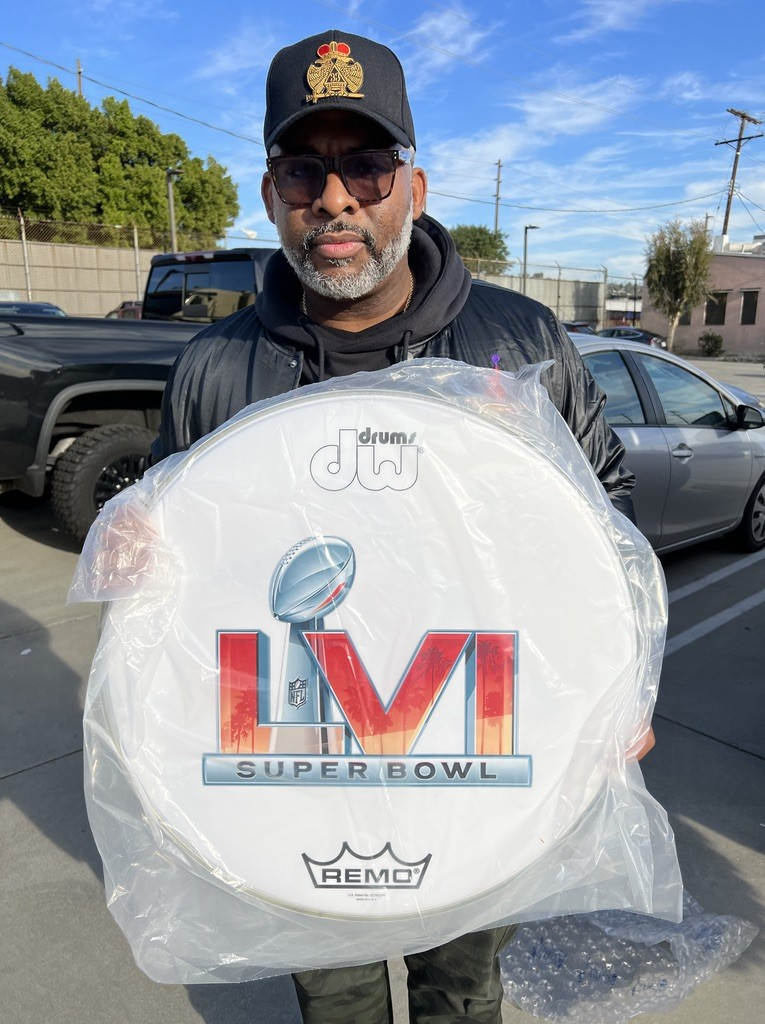
Trevor with a commemorative drumhead for his Super Bowl halftime performance.
As far as hip hop goes, I’m also equally on both sides of music. I’m a drummer and session drummer and a writer and producer. I’ve written songs with Eminem, Lionel Richie, Alicia Keys, and Bruno Mars. I was a staff producer with Dre from about 2009 till about 2022, after we did the Super Bowl. I played drums for that Super Bowl halftime show.
Local 47: You’ve been a Local 47 member for a long time. When did you first join the union?
TL: I’ve been there since I was probably 18. One of the greatest things about union membership has been all the funds like the Special Payments Fund and the Film Musicians Secondary Markets Fund. Musician. We used to fund our summer vacations during my kids’ childhood with distributions from those funds. We would always be so excited walking to the mailbox to see if we received a check and how much it was for. what the check is. When I did Man of Steel, that first check was very nice.
The rehearsal rooms are a great benefit too. I’ve used them maybe three times now. The local is always attentive and it’s always fun. I was thinking about donating some drums there. One day I’ll go through my stuff and see what would be good to give to the local for their rooms.
Local 47: While you have had an amazing drumming and producing career, you have recently become involved in the app and software side of things. Can you tell us a little about that?
TL: Over the last 9 months, I have developed 20 apps, including the popular Snare Lab, 5 books, 6 plugins, plus a digital audio workstation (DAW). Between those projects and my podcast, which I interview some of our greatest creatives, my music career is taking a little break from only creating and performing music. I still work with Dre among other things but it’s just interesting to do something completely music-adjacent yet different. And it’s been very fulfilling.
So, I have either my main site, trevorlawrencejr.com and then my tech site, trevbeatsmultimedia.com. Okay, and then I have an and then I have an app that’s just for my ecosystem called the TrevBeats App or TrevBeatsApp.com
Local 47: What are some of the apps and plugins that you have created?
TL: There is The Snare which has samples of 25 of my snares with 16 mics and all these different ways of hitting the drums. It’s a gigantic snare product that has 6.4 GB sample library. You can pretty much make any snare sound you want. It’s very robust.
I have a plugin called the Drum Pimp Hub, which has a 16×16 drum sampler, a synth, a sample editor, and more. You can type in a chat box and pretty much create whatever sound.
There’s also Perm, a plugin that looks literally like a box of hair relaxer, and its whole design is it takes MIDI notes and lays them back to generate different feels by shifting notes to create a laid-back pocket. using the term Perm this way is something I’ve been doing for years and inspired by the song Perm which I co-wrote with Bruno Mars.
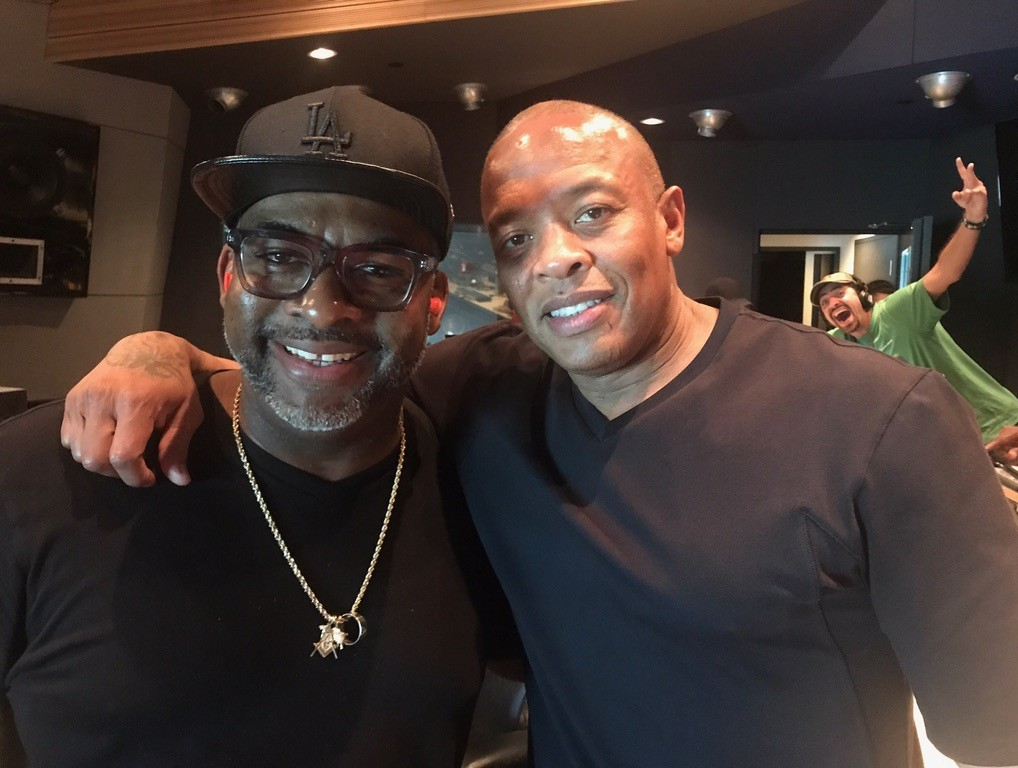
Trevor with Dre, with whom he has worked with on many projects over the years.
And I just released a DAW called Phase, which has a unique chat component that lets the user describe what he or she wants on a track, and Phase comes up with something quickly. You can type, “Hey, make the snare drum sound more jazzy,” and it will create that chain.
I have many other plugins including Lyngo, Inceptor, SpAIce, and the Snare Lab app. You can browse them all at trevbeatsmultimedia.com.
Local 47: Tell me about your involvement with AI?
TL: I did a full AI album three years ago to mark the time because I knew we were going to be where we are now. So, you know, I’ve been in this fight on both sides of it for a long time, and I have my thoughts about it. I love some of it, I hate some of it. But it’s not going anywhere, so I’m not going to just complain about it. You know what I mean?
I have AI in so many facets of my work right now. I even wrote a book on it called Vibe Coding for Musicians and Creatives.
I wish people would utilize AI in a creative way and embrace it. I’m trying to lead by example. I make everything, so even though it’s vibe coding, we’re talking about sometimes 20-30 builds for one product. There’s no way I could do any of this if I hadn’t embraced AI.
In the end, AI is just another technology that you can use nefariously or positively. And I choose to use it positively to help me grow, to help me scale, and to help me have output beyond belief.
Local 47: Being a musician nowadays appears to be a more multifaceted career than maybe the old days of focusing singularly on playing an instrument.
TL: Yeah, a lot of that is because of the high cost of living, especially in L.A. It’s very hard to just do one thing in Los Angeles right now. I’ve always believed in multiple income streams, even as a musician. I invented the Clap Stack, for example. That’s been great and it’s approaching a decade.
Then you do something else, and it’s like, “what’s next?” So, I feel like that’s kind of what it needs to be. Drummers nowadays have to know about technology, whereas before they didn’t really have to. Like if you don’t know how to work one of the V-drum models, or a DAW or an MPC it’s like, dude, you’re not really being realistic. So that’s another way things evolve.
Local 47: You have a popular podcast on YouTube. What is the show about?
TL: It’s called Trev Beats Show and features a new guest every Saturday at 4pm PST on YouTube. It’s now up to Episode 38. The guests have included Jim Keltner, James Gadson in what was his last interview, DJ Quick, Patrice Rushen, John Patitucci, and the Pocket Queen. These are all my friends and bring such a wealth of music knowledge and experience to the show.