
Member Spotlight
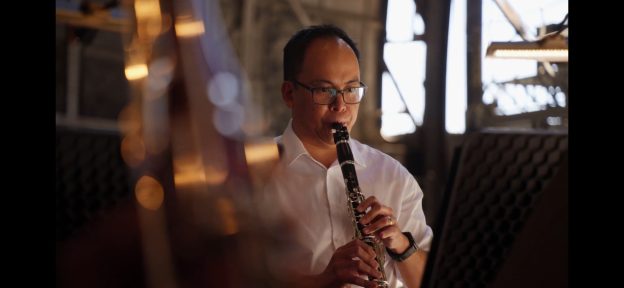
AFM Local 47 member Jonathan Sacdalan is a clarinetist, studio musician, orchestral musician, and music educator in the Los Angeles area.
His recent movie projects include Disclosure Day, Toy Story 5, Minions & Monsters, Star Wars: The Mandalorian and Grogu, Avatar 3: Fire and Ash, Avatar 2: The Way of Water, Avatar Aang: The Last Airbender, and Final Destination: Bloodlines. His TV work includes Star Trek (all current six franchises), Gremlins: The Wild Batch, Lion King at the Hollywood Bowl, and Encanto at the Hollywood Bowl.
In addition, he has recorded on albums by Barbara Streisand, Seth MacFarlane, and Michael Bublé and has done video game work including League of Legends and Genshin Impact.
Jonathan makes regular appearances as a substitute musician for many local orchestras including LA Opera, Pacific Symphony, Pasadena Symphony, Santa Barbara Symphony, the LA Chamber Orchestra, Redlands Symphony, Modesto Symphony, and the San Bernardino Symphony.
Beyond performance, Jonathan works with music outreach programs as a way of giving back and making a positive impact on the local community.
Local 47 sat down with Jonathan to talk about his music career.
Local 47: What got you interested in the clarinet?
JS: Funny enough, the clarinet wasn’t supposed to be my instrument. When I started beginning band in fourth grade, I naturally chose the saxophone. But there was a mix-up at the music store, and my family accidentally brought home a clarinet instead—and I just stuck with it!
Growing up as a first-generation Filipino kid, money was tight at times, so I learned to make the best of what I had. Over time, the clarinet really grew on me.
Then, in 1992, Aladdin was released, and hearing the music in that film exposed me to a style of orchestral playing I had never experienced before. The orchestra had such depth, color, and vibrancy. Even the classical recordings I had at home couldn’t quite match what I was hearing.
That sparked a profound curiosity about what was happening “behind the glass” in Hollywood.
Great film music was abundant during the 1990s. In many ways, my musical upbringing happened in movie theaters. I grew up during the Disney Renaissance, and soundtracks like The Lion King, Pocahontas, and Mulan had a huge influence on me. I also remember running home from the park to catch televised broadcasts of John Williams conducting at the Hollywood Bowl. And, like many others, Star Trek was my ultimate TV “comfort food” during the 1990s.
All of those films, television shows, and their music ultimately inspired me to pursue a career in music, with the goal of becoming a studio musician.
At the time, that career path went against some expectations within my cultural community about what was considered an acceptable or stable profession. But those experiences shaped my determination to pursue music anyway.
Looking back, it’s pretty amazing—and a little funny—to think that an accidental clarinet purchase in fourth grade set me on this path.
Local 47: Where did you go to college?
JS: I went to Cal State Fullerton for my bachelor’s degree, then attended UCLA, where I earned my master’s and doctorate degrees in performance. I’ve learned so much from these schools, but I realized that so much of what I learned about navigating the professional world came after college.
Working in Hollywood was very different from what I had grown up around, so having mentors who could help me understand that world was incredibly important. Gary Gray and Anthony Parnther were both major influences for me. They helped me understand not only how to approach music, but also how to conduct myself as a professional and navigate a career in the studio world.
Local 47: How did you become a studio musician?
JS: Graduating college at the height of the 2008 financial crisis was really bad timing. Because of the economic downturn, I lost many of my students, and there really weren’t many performance opportunities available at the time. It was a difficult period, and I remember calling my mentor, Gary Gray, feeling distraught and uncertain about what I was going to do.
He gave me a very simple piece of advice: “Persevere.”
So that’s what I did.
I kept working, kept playing, and kept looking for opportunities, even when there was no clear path forward. A few years later, I finally met a handful of colleagues who became important advocates for me and helped open the door to the studio community.
I’m sincerely grateful to Anthony Parnther, Tim Loo, and Gina Zimmitti for believing in me and giving me those early opportunities. Their support was instrumental in helping me get my foot through the door, and I’ll always be grateful for the trust they placed in me.
Gary’s advice was only one word—but it turned out to be exactly what I needed to hear. Show up through the ups and downs and be ready when an opportunity presents itself. In the end, we never really know where our careers will lead but I’m grateful for the opportunities and the colleagues I get to work with.
Local 47: Playing for sessions vs. the orchestral world
JS: I think concert-hall orchestral playing gives you a little more latitude to prepare and shape a solo within a larger work. You draw on a deep knowledge of a piece that may have been written a hundred or more years ago, along with the traditions and interpretations that previous performers developed around that repertoire. There’s a beautiful sense of generational continuity.