
AFM Local 47 Member Spotlight
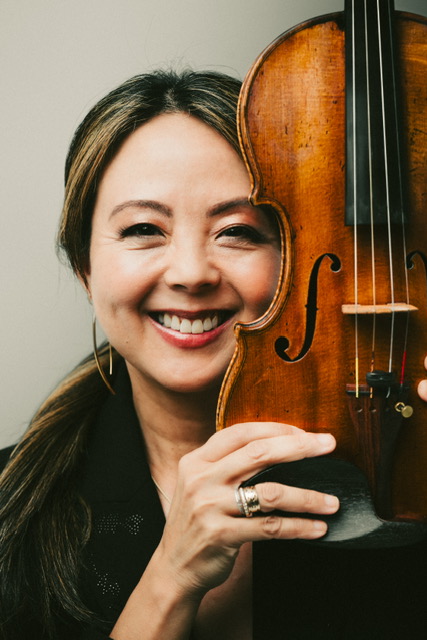
AFM Local 47 member Alyssa Park is an internationally known violinist and has been appointed as the new concertmaster of the Los Angeles Opera. She has served as concertmaster for the New West Symphony since 2015 and has been the first violinist of the Lyris Quartet since 2008. She has toured all over the world and appeared as soloist with major orchestras in the U.S., Europe, Asia, and Australia. She is the youngest prizewinner of the International Tchaikovsky Violin Competition and continues to champion new music having premiered dozens of works. She is a recording artist under several labels and is also concertmaster for numerous composers for TV and Film.
Local 47 had a chance to sit down with Alyssa and talk about her illustrious music career.
Local 47: Thank you for taking the time to chat with us about your work as a musician. When did you first become interested in music? And what drew you to the violin, in particular?
AP: My parents are great lovers of classical music so the love of music was very present in our home. And beginning at a young age, I would go to symphony concerts with them.
One day I saw Itzhak Perlman playing on television. I distinctly remember turning to my mom and saying, “I have to play the violin.” I had been taking piano for just a couple months, but I made the switch to violin right away.
I felt an instant connection to the instrument, kind of like recognizing a kindred spirit. I was just immediately drawn to it.
When I was eight, I had a wonderful teacher who had encouraged me to audition for the legendary Dorothy Delay. I hadn’t realized when I auditioned for her that she had also been Perlman’s teacher along with Ivan Galamian. She was my mentor and friend for many years. I studied with her from the age of eight all through college.
Music and the violin have felt deeply personal to me from the beginning. And I was fortunate to have remarkable guidance from early on.
I did have a little bit of an unusual path, which is that in high school, I entered the International Tchaikovsky Competition in 1990. And because I was 16 at the time, I had to get special permission to compete because 18 was the minimum age cutoff. That competition introduced me to a lot of different people. I gained so much from that experience. It gave me the courage to pursue music. At that competition, I met Gidon Kremer, a famous violinist, who took me under his wing and introduced me to his European manager. Soon after signing with them, I also joined the roster of Columbia Artists in New York and started touring immediately. I enrolled at the University of Cincinnati College-Conservatory of Music, which was where my teacher, Dorothy Delay, was teaching at the time. I did manage to get a bachelor’s degree, even though it took me a bit longer because I was working. I would be in hotel rooms and receiving faxes for homework. And I think I might be dating myself here.
Local 47: With all your touring, were there any venues that struck you as amazing places to perform in?
AP: Two of the most memorable ones are the Royal Concertgebouw in Amsterdam and the Cologne Philharmonic in Germany. Both are beautiful with great acoustics. They are magical, to say the least.
Local 47: You eventually made Los Angeles your home. How has that been?
AP: I found in LA that there’s such a vitality and depth to so many different kinds of music. I discovered many dimensions of musicianship that became profoundly meaningful to me whether it be through chamber music, orchestras, teaching, and going to so many concerts and shows. I feel a deeper connection to a larger musical need and a larger musical community that I hadn’t been exposed to before.
The beauty of living in Los Angeles, especially as a freelance musician, is the variety of work opportunities. When I moved to Los Angeles is when I started getting involved in music for TV and film, a new chamber group, and orchestras. Making connections here brings opportunities, and I have met some of my closest friends here.
Local 47: Is it difficult to play a variety of roles, for example, from soloist to chamber orchestras to session work?
AP: As a freelancer, I love doing so many different things. An essential part of freelance work is understanding the area that you’re participating in.
Your stamp as a musician, your style, and your dedication will translate into all these different areas. The learning curve is much faster when you know who you are, and you’re dedicating yourself to your craft. There is a lot to learn about collaboration, listening, and being part of different communities. At the end of the day, your own playing, your excellence, and your dedication are what matter, in my opinion. A misconception can be that maybe one area doesn’t need as good a musician as another. I don’t agree. You really must have the focus and the dedication to be the best musician that you can be. That will pay off in all those different areas.
At one concert, a hall might be packed. But then you perform elsewhere and only half the seats are filled. Or you play in a local jazz club with a more intimate audience. It doesn’t matter to me if there’s one person in the audience or 3,000. My preparation for a small audience or a large audience is essentially the same.
Local 47: Despite your experience and accomplishments, do you sometimes still feel like you’re learning?
AP: Definitely. I’m learning all the time. I recently took a new job as concertmaster of LA.
And it’s fascinating. I’m amazed that I’m 50 years old and now in a new medium. I get to learn something completely new. When I say completely new, I mean understanding the relationship between an orchestra and the singers, learning about how to work with a new community, a new conductor, and so on. It’s humbling and inspiring all at the same time.
Local 47: You’ve been an AFM member for over 20 years. What has union membership brought to your career as a musician?
AP: I strongly believe in the value of a labor union in the workplace. I think belonging to a union is important for musicians because it creates a structure that allows them to do their work and to do it at a high level. It provides protections that perhaps we don’t always think about. Contracts, compensation, and benefits are things that really matter in our profession.
Part of the benefit of being in a union is that we can hopefully be stronger together. Contracts are negotiated for us, and our employers follow rules set forth in the contracts. And if they don’t, we have a union to go to for help. We’re not on our own. We are part of community of union members who look out for each other.
Photo credit: Kevin Hsu.